


What a USDT savings product is
A savings or earn product lets you lend your USDT to the platform for a period and receive a return. Flexible products let you withdraw at any time and pay a variable rate. Locked products ask you to commit for a fixed term, such as 30 or 90 days, usually for a higher rate. Either way, while the USDT is in the product, it is not simply sitting in your wallet: the platform is using it.
Where the return comes from
- Lending: traders borrow USDT to trade with leverage and pay interest. When demand for leverage is high, rates rise; when markets are quiet, they fall.
- Funding rates: on perpetual futures, one side pays the other a regular fee. Some products earn this by holding offsetting positions.
- Promotions: a higher rate on the first few hundred dollars is a marketing cost the platform pays to win customers. It is real but temporary and capped.
- Reserves and treasury income: some platforms pass on part of the income from the reserves they hold.
Reading the numbers: APR, APY and tiers
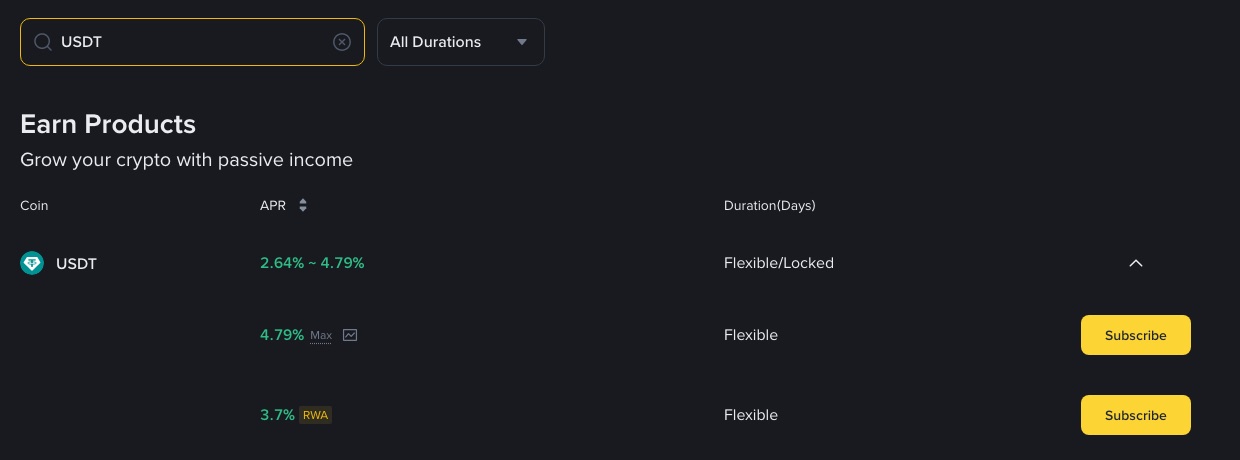
APR is the simple yearly rate. APY includes compounding, the interest earned on earlier interest, so it is slightly higher for the same product when rewards are paid daily and reinvested. Platforms often show a range: the top of the range usually applies to a small first tier, such as the first few hundred USDT, while the rest earns the lower rate.
A worked example: 1,000 USDT at 4% APR earns about 40 USDT in a year, or around 3.3 USDT a month. If the first 200 USDT earn 8% and the rest 3%, the blended rate is 4%, not 8%. Always calculate the rate on your whole amount.
Why this is not a bank deposit
Bank deposits in most countries are covered by a deposit guarantee scheme up to a limit. Crypto savings products are not. If the platform fails, your USDT is part of its bankruptcy, and you may wait years and receive only part of it back. This is not a theoretical risk: in 2022 several large crypto lenders that paid attractive rates collapsed, and their customers' balances were frozen overnight.
There is also the risk of the token itself. USDT is designed to stay at one dollar, and it has done so through several crises, but it depends on its issuer's reserves. Earning 4% a year does not protect you against a loss of value in the token.
Read the product terms for one sentence: whether your assets remain yours or become a loan to the platform. In many earn products they become a loan, which is what makes the return possible and what makes the risk real.
The risks, in order of importance
- Platform risk: the company could fail, be hacked or freeze withdrawals.
- Liquidity risk: locked products cannot be redeemed early, or only by giving up the interest.
- Rate risk: flexible rates fall without notice when demand for borrowing falls.
- Regulatory risk: a product can be withdrawn from your country with little warning.
- Token risk: the stablecoin could lose its peg, temporarily or for longer.
How to spot a yield scam
Real yields on dollar stablecoins move with interest rates and lending demand, and are usually in single digits. Offers of 1% a day, 30% a month or 'guaranteed' returns are not products; they are schemes that pay early users with later users' money until they collapse. They often appear as 'AI trading', 'mining pools', 'liquidity mining' or investment groups on messaging apps.
- Guaranteed or fixed high returns, especially daily ones.
- Pressure to invest quickly or to recruit friends.
- An app or site you can only find through a link someone sent you.
- Small withdrawals allowed at first, then fees or taxes demanded before a larger withdrawal.
- Requests to connect your wallet and approve a transaction you do not understand.
What about DeFi?
Decentralised finance lets you lend USDT directly through smart contracts. Removing the company does not remove the risk; it replaces it with others: bugs in the contract, failures in price oracles and the chance of approving a malicious contract by mistake. DeFi requires a self-custody wallet and a good understanding of transaction approvals. It is not a place for your first experiment.
Compare with what you can get at home
Before locking USDT for a few per cent a year, compare it with a regulated savings option in your own country, including dollar accounts where they exist. In countries with high interest rates, a local savings product can pay more than a USDT product, though in a currency that may lose value against the dollar. The right comparison is the return after risk and after any currency loss you expect, not the headline rate alone.
Deciding whether it is worth it
- Ask whether you need the money soon. If yes, use only flexible products, or none.
- Calculate the return on your full amount in your own currency, using the real rate for each tier.
- Read the terms on ownership, redemption times and early-exit penalties.
- Decide the maximum you would accept losing if the platform failed, and keep no more than that in the product.
- Write down the date and rate when you subscribe, and review monthly.
Flexible or locked: a worked comparison
Suppose a flexible product pays 3% and a 90-day locked product pays 5% on 1,000 USDT. Over 90 days, the flexible product earns about 7.40 USDT and the locked one about 12.30 USDT: a difference of roughly 5 USDT in exchange for not being able to touch the money for three months. If there is any chance you will need the money, or that you will want to move it quickly if something goes wrong at the platform, that 5 USDT is the price of flexibility, and usually worth paying.
Locked products also have a redemption delay at the end of the term, and some renew automatically. Check whether auto-subscribe is on, because otherwise your money may be locked again for another term without you noticing.
Questions to ask before you subscribe
- Which company holds my USDT, and in which country is it regulated?
- Do my assets remain mine, or are they lent to the platform or to others?
- How quickly can I redeem, and what do I lose if I redeem early?
- Is the advertised rate a promotion, and for how much and how long?
- Has the platform published proof of reserves, and when was it last updated?
Does the stablecoin matter?
Products for different dollar stablecoins, such as USDT and USDC, often pay different rates. The difference reflects demand for borrowing each coin rather than safety. Before chasing a slightly higher rate on another stablecoin, read how it is backed and whether you can easily convert it back to USDT or to your currency where you live.
Proof of reserves, and what it does not prove
Large exchanges publish proof of reserves: a snapshot showing they hold at least as much of each asset as their customers' balances, often with a tool that lets you check your own balance was included. It is a useful signal and worth checking before you commit money to an earn product.
It has limits. A snapshot shows one moment, not the days in between. It shows assets, but not always all liabilities, such as loans the company has taken. And it is only as good as the auditor who checked it. Treat proof of reserves as a minimum requirement for trust, not a guarantee that a platform cannot fail.
A simple habit for savers
If you do use an earn product, set a calendar reminder each month to log in, check the current rate, confirm the balance and read the platform's announcements. Rates change, promotions end and terms are updated, and none of it reaches you unless you look.
Taxes and records
In many countries interest earned in crypto is taxable income when you receive it, valued in local currency on that day. Platforms pay rewards daily, which creates many small records. Download your earn history regularly and keep it with your trading records; our local guide has notes for your market.
In short
USDT savings products can pay a modest return, and the source is mostly lending to traders. The return comes with platform, liquidity and token risks that bank deposits do not have, and no deposit insurance. Use them only with money you will not need soon, spread across no more than you can afford to lose, and treat any promise of high, fixed or daily returns as a scam.