


Why location matters so much
Crypto exchanges are licensed and supervised country by country. A platform may hold a licence in one region, operate through a local partner in another, and be prohibited from serving residents of a third. Regulators in many countries publish lists of authorised or registered providers; using a provider that is not allowed where you live can mean weaker protection, frozen accounts or problems with your bank.
Your location also decides which payment methods you can use. A mobile-money transfer that works perfectly in one country may not exist in the next, and P2P markets are only as good as the number of active local sellers.
Step 1 — Confirm the exchange serves your country
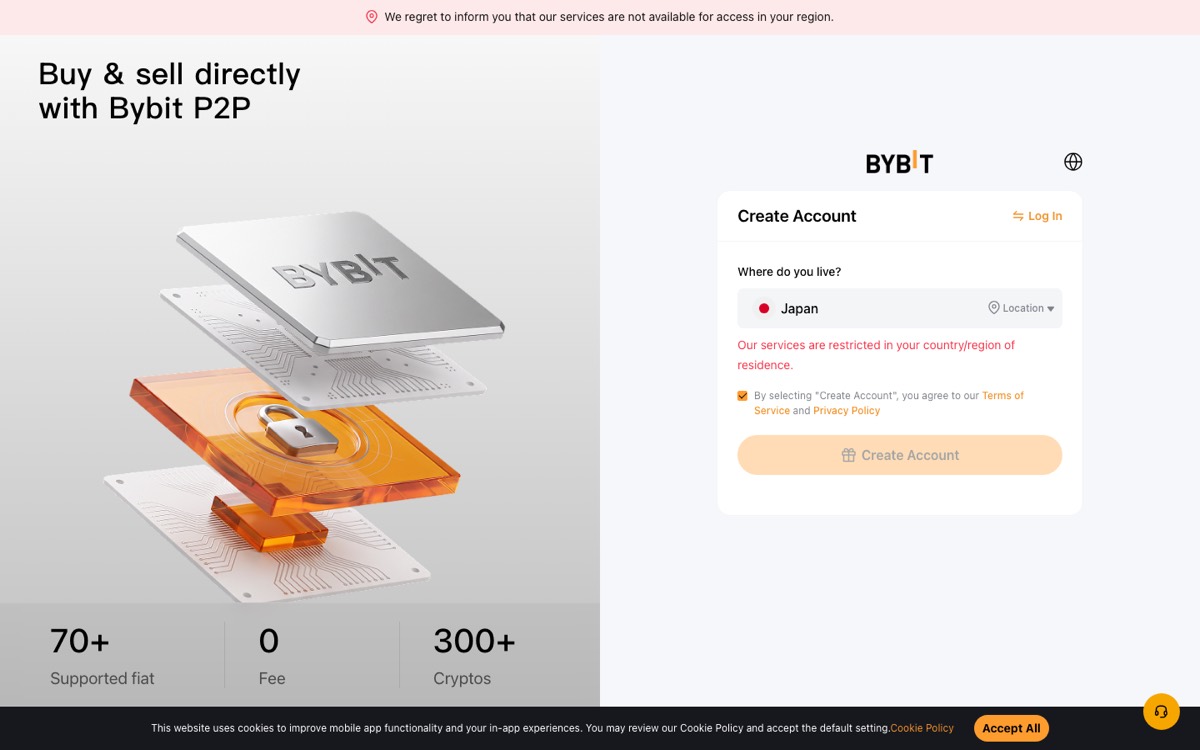
Start with the registration form: most exchanges ask for your country of residence before anything else. If your country is not accepted, you will see a clear message.
- Read the exchange's terms of use for a list of restricted jurisdictions.
- Search your financial regulator's website for the exchange's name or local entity.
- Prefer platforms that are licensed or registered locally when one meets your needs.
Step 2 — Choose a payment route that fits your country
- Local bank transfer or instant-payment system: usually the cheapest route where an exchange supports direct deposits in your currency.
- P2P with bank transfer or mobile money: the most common route in Africa, South and Southeast Asia and Latin America, where direct deposits are limited.
- Card purchase: available in many countries, but fees are higher and some banks decline crypto merchants.
- Receiving USDT from abroad: freelancers and exporters often receive USDT directly and only need P2P to cash out.
Step 3 — Check P2P liquidity in your currency
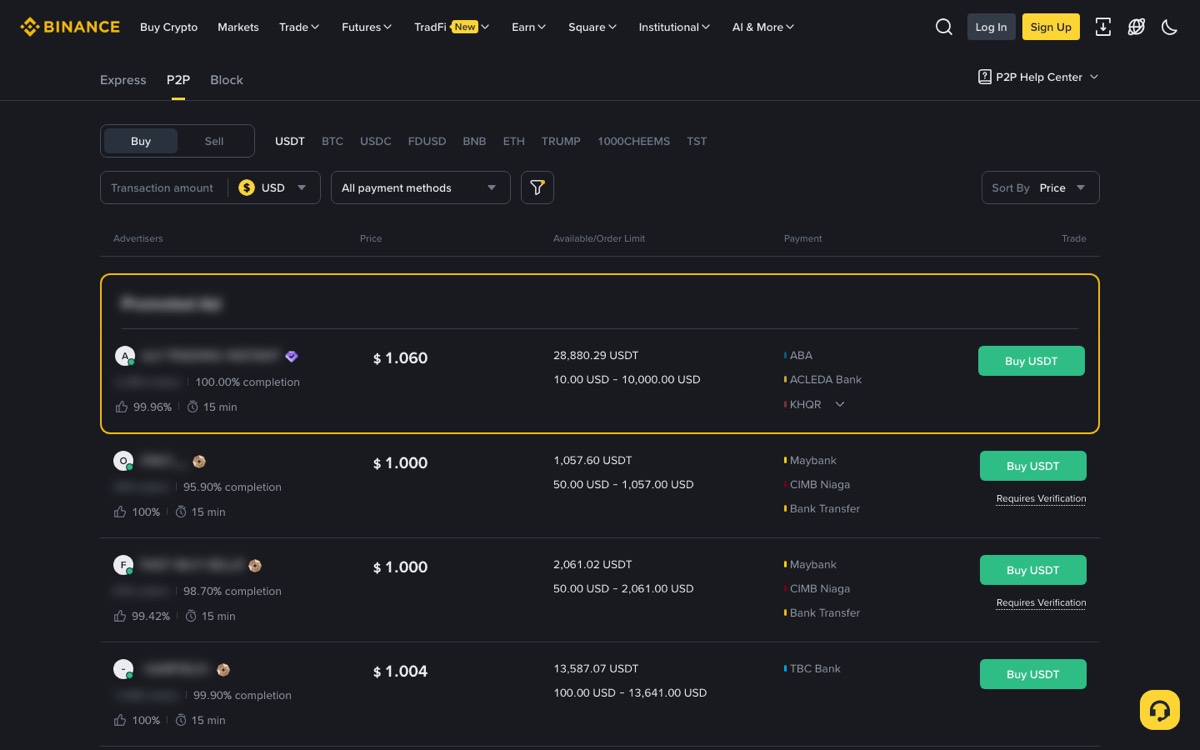
Open the P2P market, choose your local currency and payment method, and look at how many offers there are, how far prices sit from the reference rate, and the order limits. A healthy market has many sellers with high completion rates and prices within a percent or two of the reference rate. A thin market has few offers, wide spreads and high minimums.
How the picture differs by region
- Nigeria and much of Africa: P2P with bank transfers and mobile money dominates; banks' attitudes to crypto have changed several times, so check current rules before using a bank account for frequent P2P activity.
- India: centralised exchanges must register with the Financial Intelligence Unit, and crypto gains and transfers are subject to specific taxes and tax deducted at source.
- The Philippines: virtual asset service providers are licensed by the central bank; check the authorised list before signing up.
- Pakistan, Bangladesh and others: rules have moved quickly in recent years; rely on official announcements rather than social media.
- Brazil, Latin America, Turkey, Vietnam and Taiwan: see the local versions of this guide in the language menu, written for those markets.
Step 4 — Taxes and record-keeping
Almost every country treats crypto gains as taxable in some way, and many require you to report holdings or transfers even when you have not made a profit. Rules differ widely, so the only universal advice is to keep complete records.
- Download your exchange transaction history at least once a quarter.
- Keep P2P order screenshots together with the matching bank receipts.
- Note the reference exchange rate on the date of each large purchase or sale.
- Ask a local tax professional before the end of the tax year, not after.
Working with your bank
Some banks are comfortable with customers buying crypto; others restrict transfers to exchanges or flag frequent P2P payments. Using your own account, transferring reasonable amounts, and being able to show your P2P records usually prevents trouble. If your bank asks about a transfer, answer honestly and show the documentation.
Never let other people route money through your bank account for P2P, even for a commission. Accounts used this way are frequently linked to fraud and are frozen, and the account holder can face legal consequences.
Rules change — keep checking
Crypto regulation is moving quickly in many countries. A platform available today may restrict your country next year, or a new local licence may make a different platform the better choice. Revisit this checklist whenever you hear of regulatory news in your country, and keep only what you need on any one platform.
If you move or travel
Your exchange account is tied to your country of residence, not your current location. Logging in while travelling is usually fine, but if you move permanently, update your residence with the exchange and check whether the platform serves your new country. Some exchanges will ask you to complete a new verification or move to a local entity; others will ask you to withdraw your funds. Plan the move before your balance is large.
Your one-page checklist
- Confirm the exchange accepts residents of your country and, where possible, is authorised locally.
- Choose a payment method in your own name.
- Check P2P liquidity and spreads in your currency.
- Turn on security settings before depositing.
- Keep records for tax from the first purchase.
Licensed, registered or just tolerated?
Regulators use different words, and the difference matters. A licensed provider has been authorised to offer specific services and is supervised against detailed rules, often including how customer funds are held. A registered provider has usually only been checked for anti-money-laundering procedures. In some countries, foreign exchanges operate without any local status because the law does not yet cover them, which means you rely entirely on the exchange's own policies if something goes wrong.
None of this means an unregistered foreign exchange is a scam, but it changes what protection you have. For larger balances, many users split funds between a locally licensed platform for deposits and withdrawals in local currency and a large international exchange for trading.
Foreign exchange and capital controls
In countries with capital controls or multiple exchange rates, buying USDT can interact with foreign-exchange rules. The P2P price of USDT often tracks the parallel or market rate rather than the official one, and authorities sometimes restrict how banks may process related payments. Before moving significant amounts, read your central bank's current guidance and keep your activity clearly documented.
Planning the way back to local money
Beginners often plan how to buy USDT and forget to plan how to sell it. Before you buy, check that you can also sell into your currency on the same platform: look at the sell side of the P2P market, the payment methods buyers use, and any limits on fiat withdrawals. A route in that only works one way can leave you holding USDT when you need cash.
Local costs that are easy to miss
The cheapest-looking route is not always the cheapest in total. Add up every cost from your local money to USDT and back: bank transfer fees, card fees, the P2P premium over the reference rate, the exchange's trading fee, network withdrawal fees and, when you sell, the P2P discount and any bank charges on the incoming payment. A route with a slightly worse rate but no card fee and no withdrawal fee can be cheaper overall.
Our converter shows the reference rate in ten currencies, and the network fee table shows typical withdrawal costs. Use them together to estimate your real cost before you start, and repeat the estimate if your situation changes, for example when your bank introduces new fees or a P2P market becomes thinner.
Where to find reliable information
- Your central bank and securities regulator's websites, especially their lists of authorised providers and warnings about unauthorised ones.
- Your tax authority's guidance pages on digital assets.
- The exchange's own terms of use and announcements, read on its official website.
- Established local news outlets rather than social-media posts or messaging groups, which often spread outdated or invented rules.
In short
Before you deposit anything, check that the exchange legally serves your country, pick a payment route in your own name, confirm there is enough P2P liquidity to buy and to sell, add up the full cost, keep records from day one, and revisit these checks whenever the rules in your country change. Doing this once, carefully and calmly, saves a great deal of trouble and money later.