


The 30-second answer
USDT, also called Tether, is a cryptocurrency token designed to always be worth one US dollar. It lives on blockchains such as Tron, Ethereum and BNB Smart Chain, so it can be sent anywhere in the world in minutes, at any hour, without a bank in the middle.
Most cryptocurrencies are volatile: Bitcoin can move 5% in a single afternoon. USDT is deliberately boring. Its job is not to go up in price; its job is to stay at $1 so that people can hold dollars, move dollars and trade other coins without converting back to their bank account every time.
That is why, on almost every exchange, coins are priced against USDT. When you see "BTC/USDT 61,600", it means one bitcoin costs 61,600 USDT — which is roughly 61,600 US dollars.
How can a token stay at one dollar?
Tether Limited, the company that issues USDT, says that for every token in circulation it holds at least one dollar's worth of reserves: mostly short-term US government bonds (Treasury bills), cash and cash-like deposits, plus smaller amounts of gold, bitcoin and secured loans.
In theory the mechanism is simple. Large, verified clients can send Tether one dollar and receive one USDT, or send back one USDT and receive one dollar. If USDT trades at $0.99 on the market, professional traders buy it cheaply and redeem it for a full dollar, pushing the price back up. If it trades at $1.01, they create new tokens for a dollar and sell them, pushing the price back down. This arbitrage is what keeps the price glued close to $1.
Ordinary users never deal with Tether directly. You buy USDT from an exchange or from another person on a P2P market, and you sell it the same way. The price you pay in your local currency is simply the dollar exchange rate plus whatever small premium or discount your local market is charging that day.
Check the reserves yourself
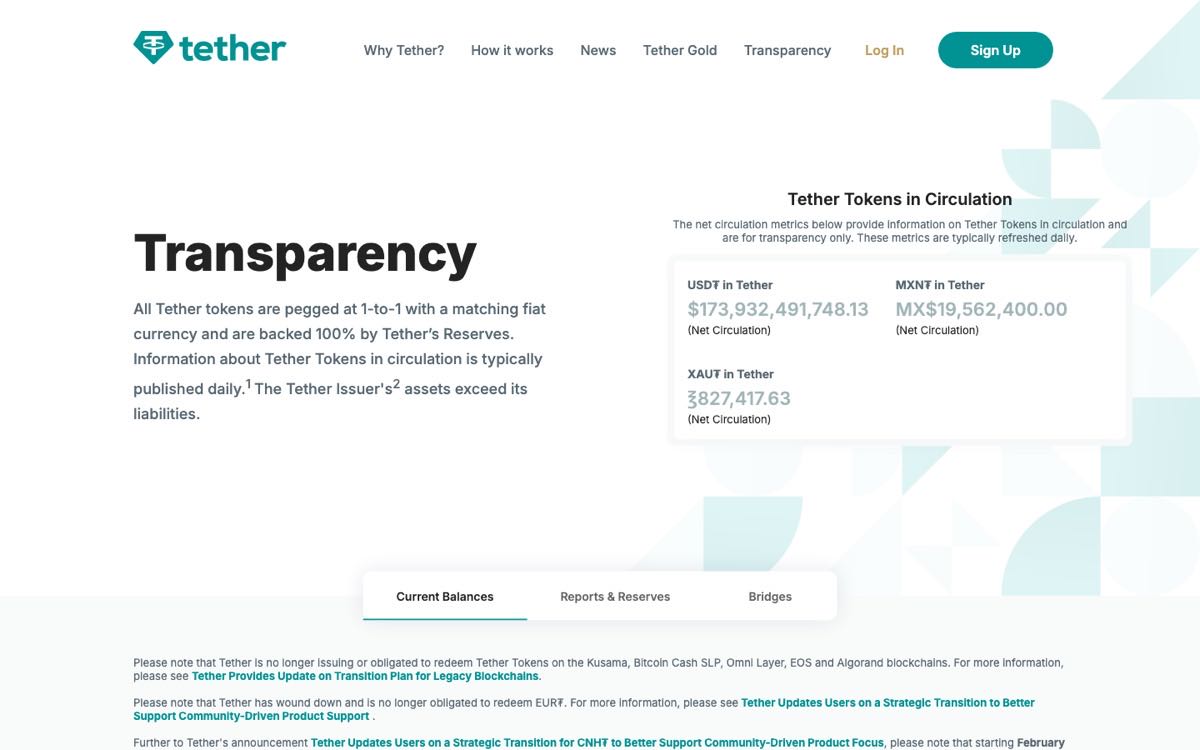
You do not have to take anyone's word for it. Tether publishes a transparency page showing how many tokens exist and links to quarterly reports on its reserves prepared by an accounting firm. When we checked, the page showed about 173.9 billion USDT in net circulation.
A reserve report is not the same as a full audit, and critics have pointed this out for years. But being able to see the circulation figure, the composition of the reserves and the history of the reports is a big step up from simply trusting an advert.
USDT is a token on many blockchains
USDT is not its own blockchain. It is a token issued on top of other networks. The original large issue was on Ethereum (the ERC20 version), followed by Tron (TRC20), and later BNB Smart Chain, Solana, TON, Arbitrum, Polygon and others.
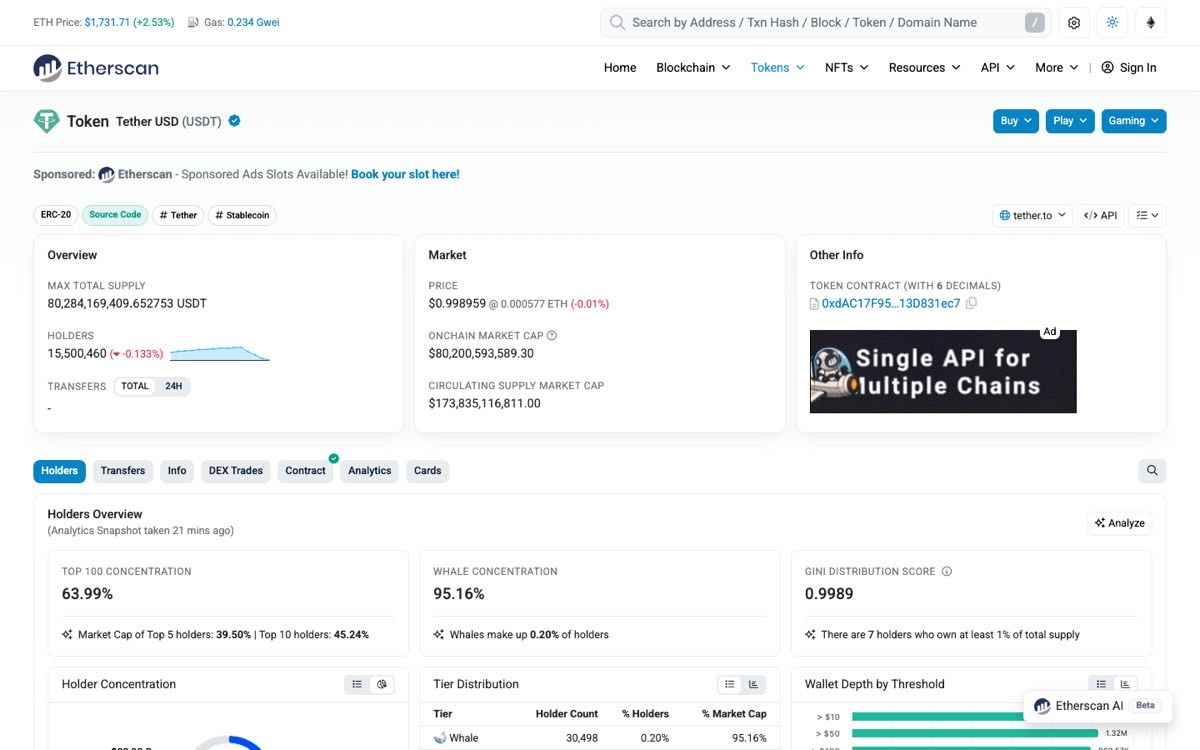
Each version has its own contract address — a kind of official ID on that blockchain. Anyone can look up the Ethereum version on a blockchain explorer such as Etherscan and see the total supply, the number of holders and every transfer ever made. This openness is one of the reasons USDT became the default "digital dollar".
The important practical consequence: USDT on Tron and USDT on Ethereum are the same asset economically, but they travel on different roads. When you send USDT you must choose the correct network, which we explain in detail in our network guide.
What people actually use USDT for
- Saving in dollars when the local currency is losing value. In countries with high inflation, holding USDT is often easier than opening a foreign-currency bank account.
- Receiving payment from abroad. Freelancers and online sellers are frequently paid in USDT because it arrives in minutes and the fee is usually under a dollar.
- Buying other cryptocurrencies. Almost every coin on an exchange is traded against USDT, so it is the natural first step.
- Parking profits. Traders sell volatile coins into USDT to lock in gains without leaving the exchange.
- Family remittances. Sending USDT and letting the recipient sell it on a local P2P market can be cheaper than a money-transfer office, although it requires more care.
The risks nobody puts in the advert
USDT is designed to be stable, but "stable" does not mean "safe". Before you hold any meaningful amount, understand these five risks:
- Issuer risk. Your dollar value depends on Tether managing its reserves well and being able to pay out during a crisis. There is no government deposit insurance.
- De-peg risk. In stressful markets USDT has briefly traded below $1 (for example around $0.95 in 2022). It recovered, but a de-peg can happen exactly when you need to sell.
- Freezing. Tether can freeze tokens at specific addresses, usually at the request of law enforcement. Honest users are rarely affected, but funds received from a scam can be frozen in your wallet.
- Platform risk. If you keep USDT on an exchange, you also depend on that exchange staying solvent and honest.
- Transfer risk. Sending USDT on the wrong network, to the wrong address, or to a scammer is usually irreversible. There is no bank to call.
Never keep more on one platform than you could survive losing, and never treat USDT as a savings account guaranteed by a bank. It is a useful tool, not a risk-free deposit.
Why your local price for 1 USDT changes every day
Because USDT follows the US dollar, its price in naira, pesos or rupees moves with the dollar exchange rate. On top of that, P2P markets add their own premium: when many people want dollars and few want to sell, USDT can cost a few percent more than the official exchange rate.
A good habit is to check a reference rate before you buy. Our converter shows the current USDT value in ten currencies, refreshed every few minutes. If a P2P seller asks for a price far above the reference, either the market is unusually tight that day or you are looking at a bad offer.
Write down the reference rate before you open a P2P order. If the seller's price is more than 2–3% above it, look at other offers or wait.
USDT compared with other stablecoins
USDC, issued by Circle, works the same way and publishes monthly attestations; it is popular with US-regulated platforms. FDUSD and others are newer and have smaller markets. For beginners in emerging markets, USDT usually has the deepest P2P liquidity and the most payment methods, which is why most local guides — including ours — start with it.
Whichever stablecoin you use, the same rules apply: understand who issues it, keep transfers simple, and do not chase "interest" offers that promise more than a bank would pay.
What to do next
If you are ready to try, the next guide walks through your first purchase step by step, from choosing an exchange to placing the order. Read the network guide before your first withdrawal and the P2P safety guide before paying any seller.
Where new USDT comes from — and where it goes
New USDT is created ("minted") when a large verified client sends dollars to Tether, and destroyed ("burned") when a client redeems tokens for dollars. Because every mint and burn happens on public blockchains, analysts can watch supply grow and shrink in real time. Rapid growth in supply is often read as a sign that more money is entering the crypto market; large redemptions can signal the opposite.
For an ordinary user this matters for one reason: the total supply on Tether's transparency page should roughly match the reserves in its reports. If the two ever diverged badly, the dollar peg would be at risk. Checking that page once in a while takes a minute and keeps you informed.
Five common myths, corrected
- "USDT is the same as dollars in a bank." It is not. It is a claim on a private company's reserves, with no deposit insurance.
- "USDT never changes price." It is designed to stay near $1, and usually does, but it has briefly moved below $1 in market panics.
- "You can earn safe interest on USDT." Any platform paying interest is taking risk with your coins. High promised yields are the classic sign of a scheme that will collapse.
- "Anything called USDT is real." Scammers create fake tokens with the same name. Real USDT has a specific contract address on each network, which exchanges and explorers recognise.
- "Crypto transfers can be reversed if there is a mistake." Blockchain transfers are final. Only the receiving party can choose to send funds back.