


What P2P is, and why escrow matters
On a normal exchange you trade with the exchange's order book. On P2P you trade with an individual seller — called an advertiser or merchant — who posts an offer: a price, a minimum and maximum amount, and the payment methods they accept.
When you open an order, the platform locks the seller's USDT in escrow. You then send money from your bank or wallet to the seller. When the seller confirms they have received it, the platform releases the USDT to you. The escrow is your protection: the seller cannot take your money and keep the coins, because the coins are already locked.
That protection only works if you follow the process inside the platform. Almost every P2P scam is an attempt to pull you outside it.
How to read a P2P listing
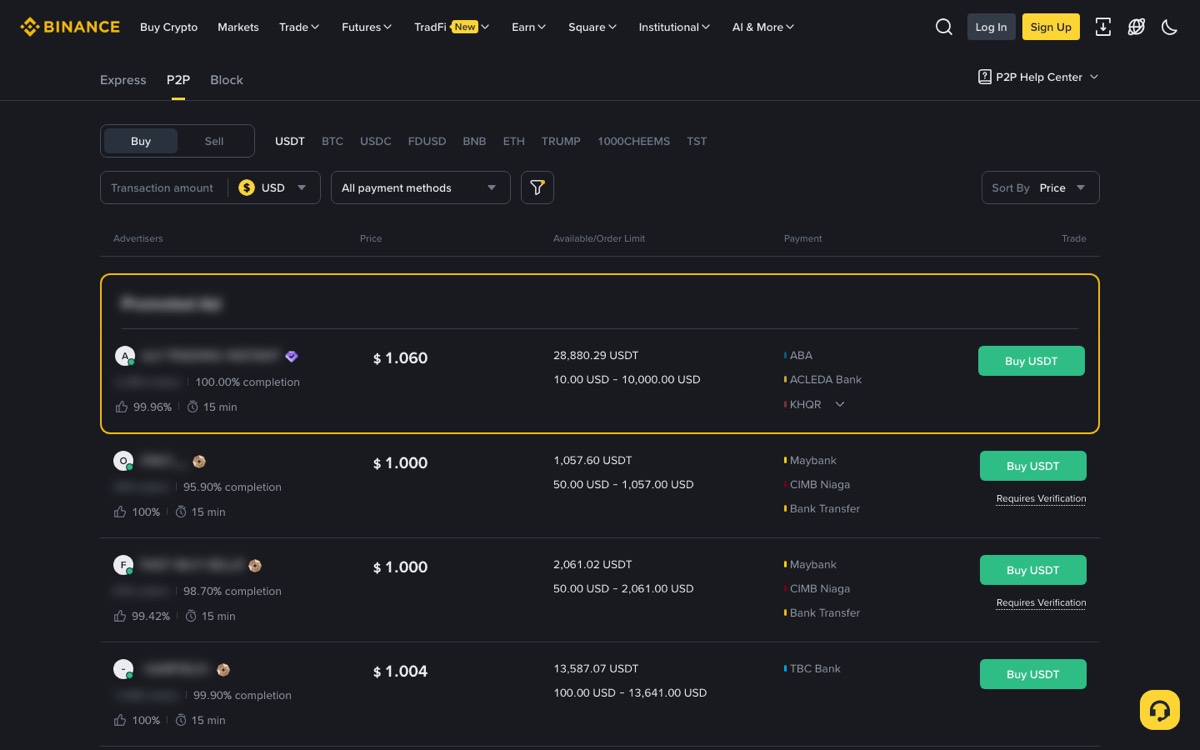
A P2P market lists offers from many sellers. Each row tells you most of what you need to decide. Here is a real listing, with the sellers' names blurred:
- Price: how much local currency you pay for 1 USDT. Compare it with the reference rate before you choose.
- Available / limits: how much USDT the seller has, and the smallest and largest order they accept.
- Payment methods: the banks or apps the seller accepts. Use only methods in your own name.
- Orders and completion rate: how many trades the seller has completed and what percentage they finished without cancelling. Prefer high numbers on both.
- Payment window: how long you have to pay after opening the order, often 15 minutes.
A safe purchase, step by step
- Set your currency and payment method, and filter for the amount you want to buy.
- Choose a seller with many completed orders, a high completion rate and a price close to the reference rate.
- Open the order and read the seller's terms. Some ask you not to mention crypto in the payment note; some only accept certain banks.
- Pay exactly the amount shown, from an account in your own name, using the details shown inside the order.
- Return to the order and tap "I have paid" or "Transferred, notify seller".
- Wait for the seller to confirm. The USDT is then released to your account. If the seller does not respond, use the in-order appeal button — not WhatsApp, not Telegram.
Golden rules
- Never pay to details sent outside the order page.
- Never move the conversation to WhatsApp, Telegram, Signal or a phone call.
- Never click "I have paid" before the money has actually left your account.
- Never pay from, or receive money into, someone else's account.
- Never release coins as a seller until you see the money in your own bank app — not a screenshot.
- Never share your password, 2FA code or screen with anyone claiming to be support.
The scams beginners meet most
- Fake payment proof: a seller-side scam where a buyer sends a convincing screenshot. If you ever sell, trust your bank balance only.
- Triangle fraud: a scammer uses your P2P order to make a victim of a different scam pay you. You receive "real" money that the victim later reports as stolen, and your bank account is frozen.
- Fake support: messages or calls from "customer service" asking you to cancel, release, or move funds "for verification". Real support never contacts you first on social media.
- Too-good prices: offers far below the market price that exist to lure you into a chat outside the platform.
- Chargeback abuse: buyers who pay by reversible methods and then reverse the payment after receiving USDT. Reputable P2P markets restrict reversible methods for this reason.
If someone pressures you to hurry, to leave the platform, or to do something "just this once", stop. Pressure is the scammer's main tool. A real seller is happy to wait for the platform's process.
Keeping your bank account safe
Banks in many countries watch for transfers linked to crypto and may freeze accounts that receive money from many strangers. As a buyer you send money to one seller at a time, which rarely triggers problems. Keep transfers in round, reasonable amounts, use the payment note the seller asks for, and keep your P2P order history in case your bank asks.
If you start selling regularly, read your bank's terms and local rules first. Frequent P2P selling can look like a money business to a bank or tax office.
When something goes wrong
Every P2P order has an appeal or dispute button. Use it as soon as something is wrong: the seller asks for a different payment method, the payment window is about to expire and they are not responding, or you paid and they have not released. Upload your payment proof from your bank app, keep all communication inside the order chat, and wait for the platform's reviewer.
Before your first real order, read the P2P help center of the exchange you use. It explains exactly what counts as valid proof and how long appeals take.
Choosing between offers: a worked example
Suppose the reference rate for 1 USDT is 1,500 units of your currency and you want to buy 100 USDT. Offer A asks 1,505 from a seller with 2,300 completed orders and 99% completion. Offer B asks 1,480 from a seller with 12 orders and 71% completion, and their terms say "contact me on Telegram for faster release".
Offer B looks 2,500 units cheaper, but everything else is a warning sign: very few orders, many cancellations, and an invitation to leave the platform. Offer A costs a small premium in exchange for a long track record. For a first purchase, the small premium is the price of safety, and it is almost always worth paying.
Merchant badges and verification levels
Many P2P markets mark experienced sellers with a badge or a "verified merchant" label. These sellers have usually completed additional identity checks, deposited a security bond with the exchange, or met volume requirements. A badge is a useful signal, not a guarantee; always combine it with the completion rate and your own common sense.
Some offers also show "requires verification". That means the seller only trades with buyers who have completed a certain KYC level or have a minimum account age. If you are new, you may see fewer offers until your account is fully verified.
If you later sell USDT on P2P
Selling reverses the roles: your USDT is locked in escrow and the buyer pays you. The single most important rule for sellers is to release only after the money is visible in your own bank or wallet app — not after seeing a screenshot, an SMS or an email, all of which can be faked. Check that the payer's name matches the buyer's verified name on the order. If it does not, do not release; open an appeal and return the money through the platform's process.
Timing: the payment window and cancellations
Most P2P orders give the buyer 15 minutes to pay. If you do not mark the order as paid within that time, it is cancelled automatically and the seller's USDT returns to them. That is fine if you never sent money — but disastrous if you did send money and simply forgot to tap the button. Always tap "paid" right after your transfer goes through.
Repeated cancellations lower your own completion rate and can limit your access to P2P. If you need more time, message the seller inside the order before the timer runs out; many will agree to wait a few minutes for a bank delay.
Bank transfers are not always instant. If your bank holds a payment for review, tell the seller in the order chat, keep the bank's reference number, and do not open a second order with another seller in the meantime. Paying twice by accident is a common and frustrating beginner mistake.
Keep records of every order
Take a screenshot of each completed order showing the order number, the amount, the price and the seller, and keep your bank's transfer receipt with it. If your bank or tax office ever asks where the money went, or if an old payment is reported in a fraud case, these records show that you bought USDT in a normal, documented trade.
In short
Stay inside the platform, pay from your own account, tap "paid" only after paying, choose sellers with long track records, and appeal inside the order when anything feels wrong. Follow those rules and P2P is a practical, everyday way to buy USDT.