


Reading a trading screen
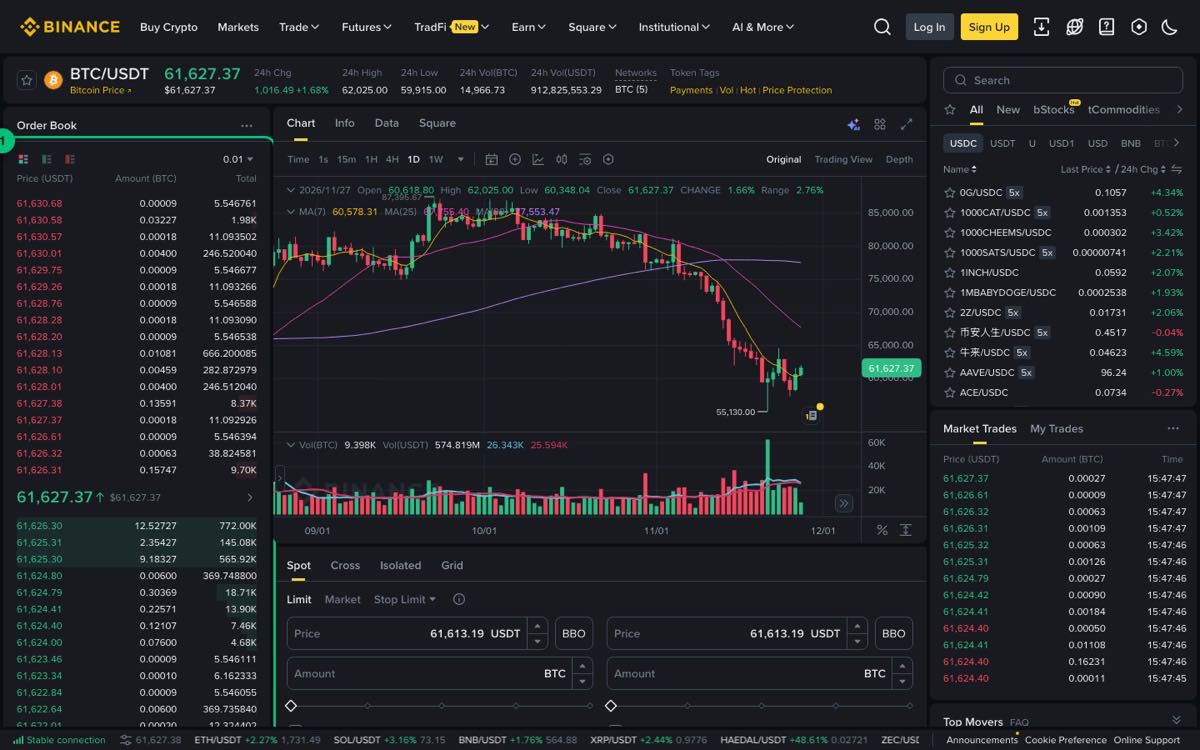
Before the definitions, it helps to see where these words appear. This is a real spot trading screen; the numbered area is the order book, and the order form with Limit and Market tabs sits at the bottom.
Trading basics
- Pair — two assets traded against each other, such as BTC/USDT. The first is what you buy or sell; the second is what you pay or receive.
- Spot — buying or selling the actual coin and paying the full price. What you buy is yours to hold or withdraw.
- Order book — the live list of buy offers (bids) and sell offers (asks) for a pair.
- Bid / ask — the highest price a buyer is offering and the lowest price a seller is asking.
- Spread — the gap between the best bid and the best ask. A small spread means a liquid market.
- Market order — buys or sells immediately at the best available price.
- Limit order — buys or sells only at the price you set or better; it may wait or never fill.
- Stop-limit order — a limit order that is only placed once the price reaches a trigger ("stop") level. Used to limit losses or catch breakouts.
- Maker — an order that adds liquidity by waiting in the order book. Usually pays a lower fee.
- Taker — an order that removes liquidity by filling against an existing order. Usually pays a slightly higher fee.
- Slippage — the difference between the price you expected and the price you got, common with large market orders in thin markets.
- Liquidity — how easily you can buy or sell without moving the price.
- Volume — how much was traded over a period, usually 24 hours.
- Candlestick — a bar on a price chart showing the open, high, low and close for a period.
- DCA (dollar-cost averaging) — buying a fixed amount at regular intervals instead of all at once, to smooth out the effect of timing.
Futures and leverage (handle with care)
- Futures / perpetuals — contracts that track a coin's price without you owning the coin. Perpetuals have no expiry date.
- Leverage — borrowing to open a position larger than your own money. At 10x, a 10% move against you can wipe out your margin.
- Margin — the money you put up to open a leveraged position.
- Long / short — betting the price will rise (long) or fall (short).
- Liquidation — the exchange closes your position automatically because your margin no longer covers the losses. You lose the margin.
- Funding rate — a small periodic payment between long and short traders that keeps perpetual prices close to the spot price.
- PnL / ROE — profit and loss, and return on equity (profit as a percentage of your margin).
Leveraged futures are not a beginner product. Most beginners who start with high leverage lose their margin quickly. Learn spot trading first, and use our futures calculator to see how close a liquidation price can be.
Accounts, verification and payments
- KYC (know your customer) — identity verification that regulated exchanges must perform before you deposit or withdraw local currency.
- 2FA — a second login step, usually a six-digit code from an authenticator app.
- Passkey — a passwordless login tied to your device that cannot be phished.
- Anti-phishing code — a secret word you set that appears in genuine emails from the exchange.
- P2P — buying from or selling to another user, with the exchange holding the coins in escrow.
- Escrow — the exchange locks the seller's coins until the buyer's payment is confirmed.
- Referral code — a code linking your account to whoever introduced you, often giving a fee discount.
- VIP level — a fee tier based on trading volume or holdings; higher tiers pay lower fees.
Wallets and transfers
- Wallet — software or a device that holds the keys controlling your crypto.
- Custodial / self-custody — whether a company holds the keys for you (exchange) or you hold them yourself (your own wallet).
- Seed phrase — 12 or 24 words that can restore a self-custody wallet. Anyone who sees it controls the funds.
- Address — the destination you send crypto to, similar to an account number.
- Network / chain — the blockchain a transfer uses, such as TRC20 (Tron) or ERC20 (Ethereum).
- Gas / network fee — the fee paid to the blockchain to process a transaction, paid in the network's own coin.
- Memo / tag — an extra identifier some networks require for deposits to exchanges.
- TxID / hash — the unique ID of a blockchain transaction, used to track it on an explorer.
- Confirmation — the network recording a transaction in a block; exchanges credit deposits after a set number of confirmations.
- Block explorer — a website that shows every transaction on a blockchain, such as Etherscan or Tronscan.
- Whitelist — a list of approved withdrawal addresses.
Market and project terms
- Stablecoin — a token designed to keep a fixed value, such as USDT ≈ 1 US dollar.
- Market cap — price multiplied by circulating supply; a rough measure of size.
- Circulating supply — the number of coins currently available on the market.
- Volatility — how much and how fast a price moves.
- Bull / bear market — a period of generally rising or falling prices.
- Altcoin — any cryptocurrency other than Bitcoin.
- Meme coin — a token driven mainly by community and online attention rather than a product. Extremely volatile.
- Airdrop — free tokens distributed to wallets, often used in scams to lure people into connecting wallets to malicious sites.
- Rug pull — a project whose creators abandon it and take the investors' money.
Safety and scam vocabulary
- Phishing — a fake website, email or message designed to steal your login details or codes.
- SIM swap — an attacker takes over your phone number to receive your SMS codes.
- Address poisoning — scammers send tiny transfers from an address that looks like one you use, hoping you copy it from your history by mistake.
- Approval / allowance — permission you give a smart contract to move tokens from your wallet; malicious approvals can drain it.
- Pig butchering — a long-con investment scam in which a friendly stranger builds trust before introducing a fake platform.
- Pump and dump — a group buys a small coin, hypes it to attract buyers, then sells to them at a higher price.
- Recovery scam — people who contact victims of a previous scam offering to recover the funds for an upfront fee.
Blockchain basics
- Blockchain — a shared public record of transactions, maintained by many computers instead of one company.
- Block — a batch of transactions added to the blockchain at once.
- Smart contract — a program running on a blockchain; tokens like USDT are smart contracts.
- Token — an asset created by a smart contract on an existing blockchain, as opposed to a network's native coin.
- Native coin — the coin a blockchain uses to pay its own fees, such as ETH, TRX, BNB or SOL.
- Layer 2 — a network built on top of another blockchain to make transactions cheaper and faster, such as Arbitrum or Optimism.
- Bridge — a service that moves tokens between blockchains; a frequent target of hacks.
- Halving — Bitcoin's scheduled reduction of new-coin rewards, which happens roughly every four years.
How to use this glossary
You do not need to memorise these terms. Come back when a word stops you, and read the related guide for context: the network guide for addresses, memos and gas, the P2P guide for escrow and completion rates, and the security guide for phishing and 2FA. Understanding a few words properly is worth more than knowing many vaguely.
Fees and costs
- Trading fee — a percentage charged by the exchange on each trade, different for makers and takers.
- Withdrawal fee — a flat fee charged when you send crypto off the exchange; it depends on the network.
- Spread cost — the hidden cost of buying at the ask and selling at the bid.
- P2P premium — how much above (or below) the reference rate a P2P seller prices USDT.
- Funding fee — the periodic payment between long and short futures traders.
- Rebate — a refund of part of the fees you paid, for example through a referral or market-maker programme.
Two more you will hear often
- FOMO — fear of missing out; the urge to buy because prices are rising fast. A common cause of buying at the top.
- HODL — holding a coin for the long term instead of trading it, from a famous typo of "hold".